5 Biggest Cross-Border Payment Challenges Businesses Face, And How Entterprice Is Solving Them
Global trade has never been easier to start. Sourcing from one country, paying suppliers in another, and collecting from customers everywhere, it's all just a few clicks now.
Moving the money behind it, though? Still messy.
Cross border B2B payments are growing fast. The B2B share of the global cross-border payments market is projected to hold over half the total market value in 2026, and a report on B2B payment volume suggests that worldwide b2b payments are expected to reach $150–180 trillion this year alone. But most of that volume is still moving through infrastructure that was never built for how fast modern trade actually runs.
Here are the five friction points we hear about most and how we're building Entterprice to fix them.
Unclear FX Costs and Hidden Fees
Most businesses know how much they want to send. Few know what it actually costs to send it.
Banks and payment providers routinely build their margin straight into the exchange rate, sometimes 2–4% above the mid-market rate, without spelling it out (Cambridge Currencies). The World Bank puts the global average cost of an international transfer above 6%, nearly double the UN's own 3% target for affordable remittances. On repeat supplier payments, that spread quietly eats real margin.
How Entterprice solves it: transparent pricing, shown against the real mid-market rate, so businesses know the true cost before they hit send, whether that's to convert AED to CNY for business payments or manage multiple currencies at once.
Lack of Payment Visibility After Sending Funds
Once a wire leaves the bank, it disappears into a black box. Has it landed? Is it stuck in compliance review? Nobody can say for sure until the supplier confirms, or doesn't.
This isn't a minor annoyance. Industry data shows the average international B2B payment takes 3–5 business days to settle, with close to a quarter taking longer than a week [4]. That's a week of finance teams chasing updates and suppliers wondering if payment is even coming.
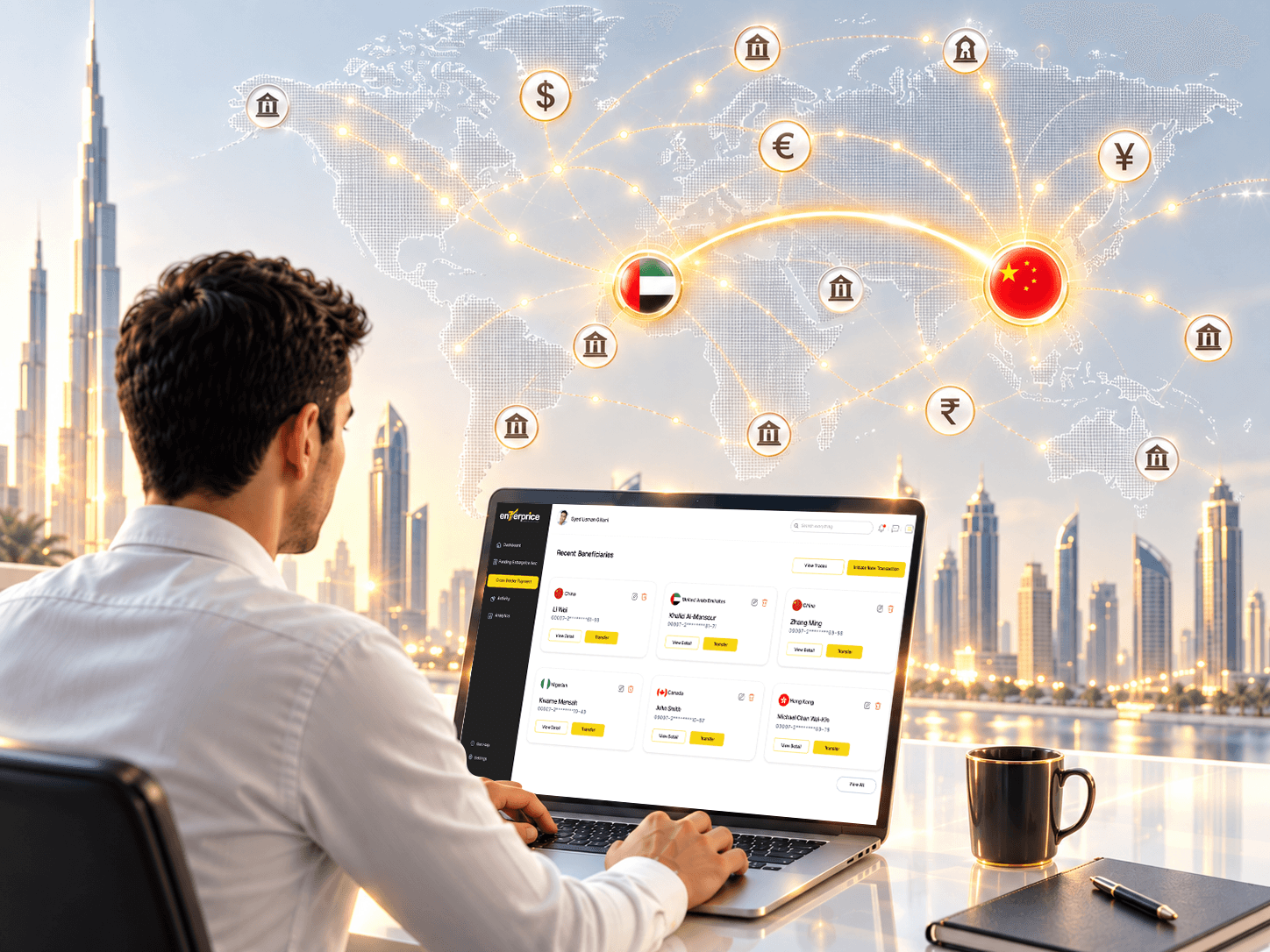
How Entterprice solves it: real-time tracking from initiation to settlement, so you always know where the money stands, no chasing required.
Slow and Complex International Transfers
Traditional transfers still route through 2–4 correspondent banks, each adding its own delay, cut-off time, and compliance check. For businesses managing supplier relationships or inventory cycles, that lag directly threatens cash flow and delivery timelines.
How Entterprice solves it: we're building an international business payments platform designed to simplify global money movement through stronger payment infrastructure and direct relationships across key trade corridors. With deep expertise in high-volume routes like UAE–China and Hong Kong, Entterprice helps businesses reduce unnecessary intermediary steps, improve settlement efficiency, and move payments with greater confidence across global markets.
Limited Flexibility Across Global Markets
Multiple currencies, multiple banking relationships, multiple portals to log into. Growth shouldn't mean more fragmentation, but for most businesses it does.
How Entterprice solves it: a multi-currency B2B payment platform built as one connected system, not a patchwork of separate banking relationships, so paying suppliers, receiving collections, and managing currency exposure all happen in one place.
Traditional Rails Weren't Built for Modern Trade
SWIFT still matters, but businesses now expect more than "eventually, it'll arrive." They want speed, visibility, and infrastructure that keeps pace with how fast trade actually moves today.
How Entterprice solves it: we're building a genuine alternative to SWIFT payments, with next-generation infrastructure including stablecoin settlement for trade on the roadmap, aimed at faster, more predictable cross-border settlement without relying on legacy correspondent chains.
The Future of Cross-Border Payments Is About Control
Businesses don't just need a way to send money abroad. They need to trust it once it's gone.
That means knowing the real cost upfront, tracking every payment in transit, handling multiple currencies without friction, and moving away from rails built for a slower era of trade.
Entterprice is building a global B2B payment solution and B2B payment platform for importers and exporters around exactly that standard: transparent, fast, and fully in your control.
Global trade is moving faster. Payments should too.