UAE to China Transfers: How to Send Business Payments Faster and With More Clarity
If you've ever tried to send money to China from the UAE, you already know it's rarely as simple as it sounds. Whether you're paying a supplier in Guangzhou, settling an invoice with a manufacturer in Shenzhen, or managing regular trade payments from the UAE to China, the process can feel slow, expensive, and at times, frustratingly opaque.
One of the busiest trade corridors in the world is the UAE-China trade corridor. The Ministry of Economy of the UAE has stated that China has always been the leading trading partner of the country, and bilateral trade is more than $102 billion in 2024. Thousands of UAE-based businesses with small importers to big trading houses are starting to make business payments with China every single week. Nonetheless, with the magnitude of this relationship, many businesses continue to use the conventional method of bank transfers, where payment takes days, the transfer is costly, and there is little visibility into where the money actually is. That needs to change.
1. Why UAE-to-China Business Payments Are Uniquely Challenging
Sending cross-border B2B payments to China is not a simple international transfer that comes with simple regulatory, currency, and operational challenges.
China's currency controls play a big role here. The Chinese yuan (CNY/RMB) is not freely convertible. The People's Bank of China (PBOC) tightly manages its exchange rate, which means businesses looking to pay Chinese suppliers from the UAE often deal with conversion delays and documentation requirements on the Chinese side.
On top of that, SWIFT-based bank transfers are still the default for many businesses and far from an ideal alternative to SWIFT payments, which typically take 2 to 5 business days to clear, and fees can stack up quickly. According to the World Bank's Remittance Prices Worldwide database, the global average cost of sending $200 internationally remains 6%, well above the UN's Sustainable Development Goal target of 3%. For businesses sending larger amounts, even a fraction of a percentage point adds up fast.
There's also the issue of transparency. Many businesses state that after the wire has been sent, it is virtually impossible to track it until it either reaches or bounces back days later with not much explanation in the between.
2. Factors to Consider When Sending Business Payments to China
Before selecting a payment method or platform, here are the major considerations every UAE business should evaluate:
Exchange Rates and Hidden Costs
The mentioned transfer cost is not often the whole thing. When you want to convert AED to RMB for business payments, most of the banks and payment companies build their own margin on the exchange rate by up to 2-4 percent above the mid-market rate without disclosing it clearly on the exchange rate. An exchange that can give you the best FX rates for international transfers when sending money abroad and has an open fee system is always better than a promise of zero fee that is secretly inflating your costs. Never look at the headline fee only.
The stated transfer fee is rarely the full story. If your goal is to convert AED to CNY for business payments, many banks and payment providers bake their margin into the exchange rate sometimes by as much as 2–4% above the mid-market rate without disclosing it clearly.
A platform offering the best FX rates for international transfers with a transparent fee structure is always preferable to a "zero fee" promise that silently costs you more. It is essential to always compare the total cost, not just the headline fee.
Transfer Speed
In international trade, timing matters. If you're looking for the fastest way to pay a Chinese supplier, a 4-day bank delay can hold up your entire supply chain. When selecting a payment method, look for the providers that can offer settlement to China on the same or next business day.
Compliance and Documentation
Cross-border business payments to China often require specific documentation, governance. invoices, contracts, and proof of trade purpose to comply with both UAE Central Bank regulations and China's State Administration of Foreign Exchange (SAFE) requirements. A good international business payments platform should guide you through this, not leave you to figure it out alone.
Payment Traceability
Real-time tracking is not a luxury anymore; it's something that people expect. Your finance team can plan, and your suppliers can ship with confidence if they know exactly when your payment was sent, when it's being processed, and when it has arrived.
Scalability
If you send payments on a regular basis, you need a B2B payment platform for importers that can handle volume without requiring manual intervention every time. If your transaction frequency is high, look out for batch payments, recurring transfers, and API integrations.
3. Common Methods for UAE-to-China Business Payments
Traditional Banks
Banks are the most familiar option when it comes to international business payments. They're trusted, regulated, and have well-established global networks. But familiarity comes at a cost. According to World Bank, bank-to-bank transfers are consistently among the most expensive ways to move money across borders, and processing times that stretch to several business days can create real friction for businesses with regular payment obligations. For high-frequency cross-border business remittance, those fees and delays start adding up in ways that affect your margins.
Exchange Houses and Money Transfer Operators
Exchange houses, especially the well-known ones that work all over the UAE, usually have better rates than banks and can move money faster. But most exchange houses run into problems when it comes to sending formal cross-border B2B payments to Chinese business accounts. They may not support the corporate paperwork that Chinese regulators need and don't have the ability to settle payments in RMB/CNY directly. This means that your payment still has to go through intermediaries before it lands.
Dedicated Business Payment Platforms and Enterprise Portals
This is where the landscape has changed the most in the last few years. For UAE companies, a multi-currency B2B payment platform has emerged as the most efficient option when it comes to trade with China. These platforms provide real-time exchange rates, digital document workflows, payment tracking, and in many cases, direct access to Chinese banking networks, bypassing slow correspondent chains entirely.
Some platforms also support a Hong Kong business payment account structure, which acts as an intermediary hub for businesses that need to manage payments across both mainland China and international markets.
According to McKinsey's Global Payments Report, the amount of digital B2B cross-border payments is expected to reach $40 trillion by 2026. This is mostly because businesses are moving away from conventional banking systems and toward purpose-built fintech solutions. The demand is real, and the tools are catching up.
4. How Entterprice Is Changing the Game for UAE-China Payments
For businesses that regularly work with Chinese suppliers, the Entterprice payment infrastructure is more than just a convenient platform; it is one connected ecosystem for your B2B payments.
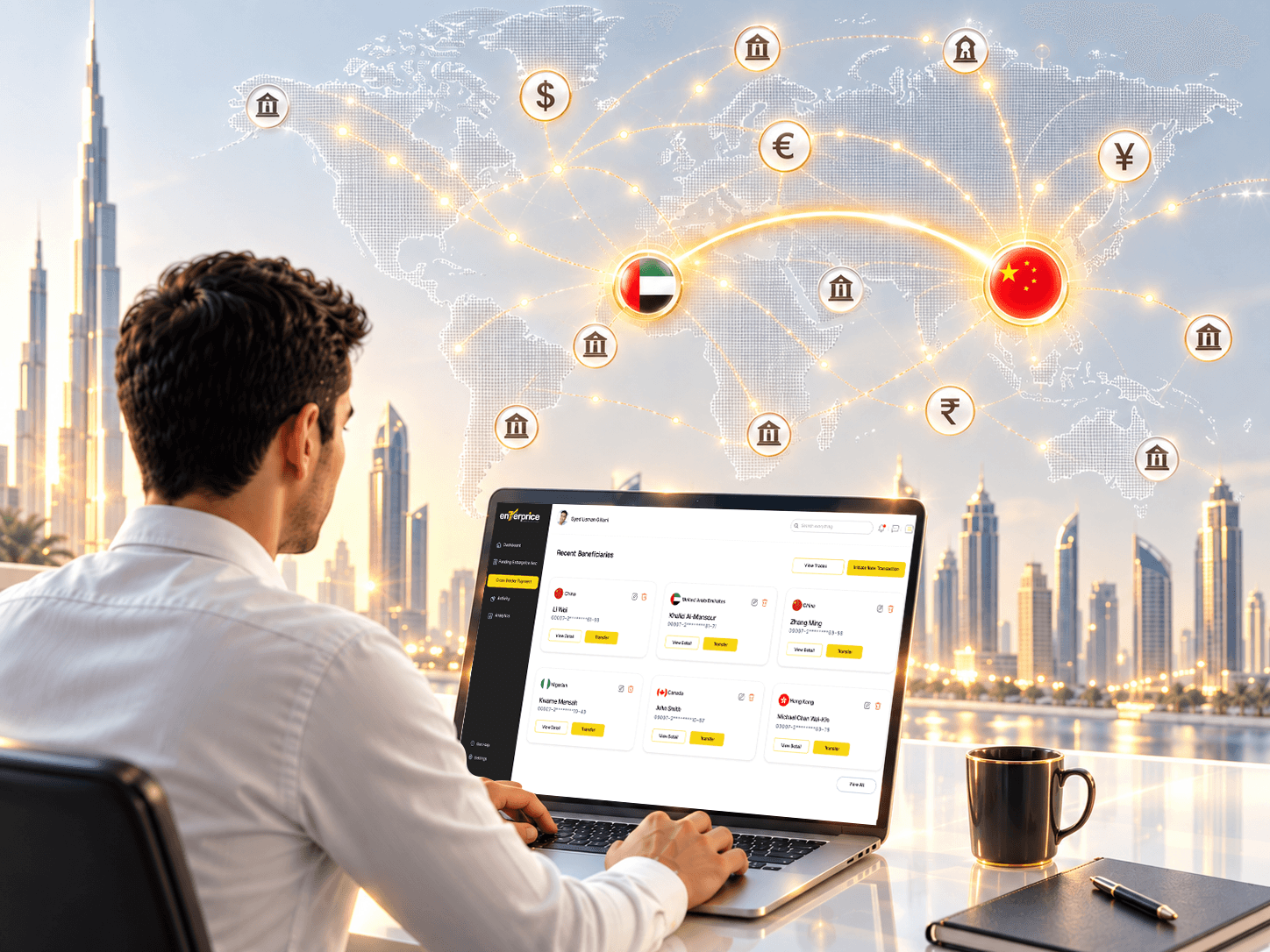
Entterprice is a purpose-built UAE-to-China payment gateway for businesses that gives UAE-based companies a faster, more transparent, and fully compliant way to manage their cross-border payments to China. Here's what makes it different:
Centralized Payment Management
Instead of using multiple bank portals or chasing a relationship manager every time a payment needs to go out, Entterprice gives your finance team a single web portal to initiate, approve, and track every outgoing payment to China, all in one place.
This is especially valuable as a virtual business account for exporters/importers who are handling multiple entities, frequent transactions, or high payment volumes. Everything is visible and traceable, and nothing falls through the cracks.
Transparent FX Pricing
With Entterprice, what you see is what you pay. The platform shows live exchange rates based on the actual mid-market rate, with a clear and fixed margin on top with no hidden charges and no surprises when the payment arrives on the other end.
As a global B2B payment solution, Entterprice also allows businesses to lock in a rate, so if the market moves between the time you approve a payment and when it settles, your cost stays exactly where you planned it.
RMB Settlement Made Simple
One of the most common questions from UAE-based importers is how to pay suppliers in RMB. Entterprice handles the entire process end-to-end, converting your AED at competitive rates, navigating China's currency controls, and delivering RMB directly into your supplier's account without unnecessary intermediary steps or delays. No more back-and-forth with banks about documentation. No more payments sitting in limbo.
Emerging Settlement Options
Entterprice is also ahead of the curve when it comes to next-generation payment rails. Some forward-thinking businesses are now exploring stablecoin settlement for trade as a way to sidestep FX volatility and speed up settlement timelines. Entterprice is actively working in this space, piloting stablecoin-based cross-border rails for the UAE-China corridor, making payments faster, more predictable, and less dependent on legacy banking infrastructure.
Compliance Built In
Entterprice is built around the rules, not around them. The platform is designed in line with UAE Central Bank regulations and China's SAFE requirements, and it prompts users to upload the right documents at exactly the right stage of the payment process. This means your payments don't get stuck, rejected, or returned because of missing paperwork, a frustratingly common problem with traditional bank wires.
Audit Trails and Reporting
For finance teams that need to reconcile payments, prepare for external audits, or present reports to leadership, Entterprice automatically generates detailed transaction histories and downloadable reports, eliminating the manual tracking work that eats into your team's time. Every payment, every rate, every timestamp, all in one place, always accessible.
5. Making the Move: What to Look for in a Payment Partner
Trade payment platforms are not equally constructed. When evaluating options for your low-cost business remittance UAE to China, here are the questions worth asking:
- Does the platform have the UAE Central Bank license and regulation?
- Does it have direct RMB/CNY settlement relationships with Chinese banks, or does it still rely on slow correspondent chains?
- What documentation is needed, and how is it managed in the platform?
- Does the company have a corporate customer service division?
- How does exchange rate margin and fees change when added to the all-in cost?
To the businesses trading substantial amounts of trade with China, these answers can save tens of thousands of dirhams annually, and a finance department with less time spent waiting to collect money and more time devoted to expansion.
Fore more guidlines and updates subscribe on to our youtube channel watch how Entterprice supports UAE–China business payments